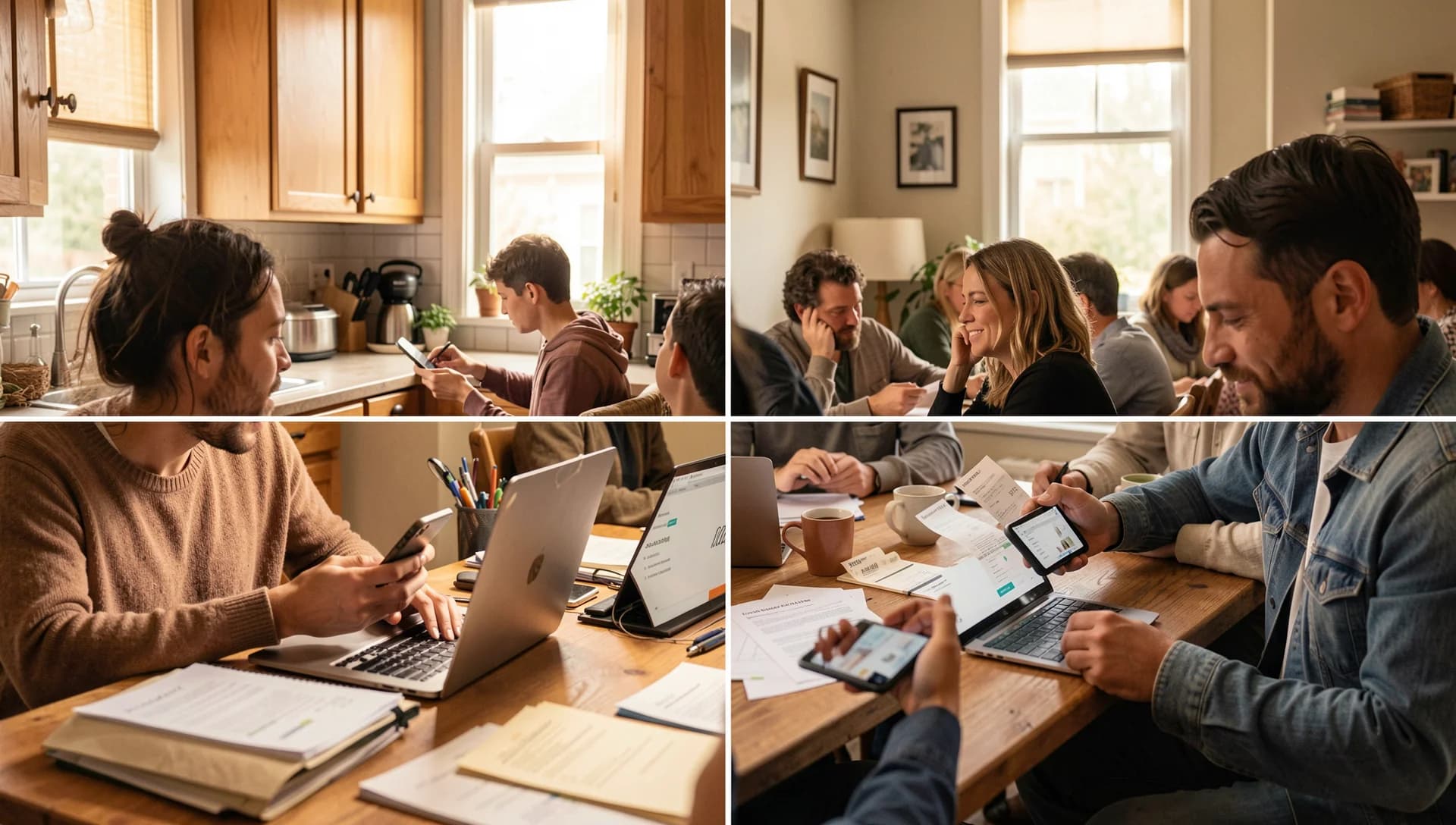
Picture your Saturday afternoon. You're sitting at the kitchen table with a pile of receipts, a spreadsheet open on the laptop, and a growing sense that you should be doing literally anything else.
Meanwhile, somewhere in the US, an orthopaedic surgeon opens his laptop at quarter past six in the morning. He describes five tasks in plain English: triage my inbox, build a teaching presentation from these notes, create a content calendar for the month, organise my downloads folder, and draft a briefing document for tomorrow's meeting. Then he goes to make breakfast. When he comes back, there are finished files waiting in his folders.
Not rough notes. Not suggestions. Actual completed documents, ready to use.
A mum in another city records rambling voice notes on her phone during a morning walk with the pushchair. She feeds them into an AI tool when she gets home. It organises her scattered thoughts into coherent research themes, writes an article in her voice, and creates shorter versions for social media. She describes the experience as "discovering something wild."
A 52-year-old sign shop manager with no coding experience and a problem that needed solving uses AI to build something an agency quoted at over a million pounds. His cost: about five hundred.
These are not hypothetical examples. They happened in the past few months.
Something Changed, and Almost Nobody Noticed
Until recently, AI meant chatbots. You typed a question, it gave you an answer, you copied it into a document. Useful, sometimes. Limited, always.
Something shifted. There is now a category of AI tools that can actually do things. Not give you advice about doing things. Do them.
They can read your files. Sort them. Rename them. Create spreadsheets from raw data. Turn a folder of messy documents into something organised. Draft, format, and save finished work into your folders without you touching a keyboard.
The difference is like the gap between asking someone for directions and having them drive you there. You end up with the same result, but one approach involves considerably less fumbling with a map.
If you have not been paying attention to this shift, you are not alone. Most people still think of AI as a slightly better search engine. That was true eighteen months ago. It is not true now.
The Receipt Problem (And Every Task Like It)
Let's go back to your kitchen table.
Someone had exactly your problem: a pile of receipt photos that needed entering into a spreadsheet. Every month, one to two hours of their life, gone. They described what they wanted to an AI tool: "take these receipt photos, extract the amounts, dates, and categories, and put them into a spreadsheet with totals." Five minutes later, they had a finished spreadsheet. Not a draft. A working file with formulas.
That same person was spending 30 to 60 minutes every week tidying their downloads folder. Renaming files, sorting them into month and type folders, removing duplicates. They described the sorting rules once. Now it takes about two minutes.
Someone else had 21,000 unread emails. Years of accumulated inbox chaos. They exported the lot and asked AI to categorise them, extract all the attachments, and organise everything into a structured archive. It produced a 9GB folder system, sorted and labelled.
Another person was maintaining contact lists across multiple systems: a CRM here, a mailing list there, a spreadsheet that hadn't been updated since 2023. AI consolidated them, flagged duplicates, and produced a single clean list.
These are admin tasks. Boring, repetitive, and exactly the kind of thing that eats your evenings if you run a small business. The people in these examples are not tech experts. They are people who described what they wanted in plain English and let a tool do the work.
It Turns Out AI Is Best When You Know Your Business
This is the part that surprises everyone, including people who work in technology.
The people getting the most from these tools are not programmers. They are people who know their work inside out.
The sign shop manager I mentioned earlier is 52. His last experience with code was BASIC in secondary school. He has spent 25 years in sign shops. He knows exactly how vinyl rolls are measured, how lot tracking works, how waste needs recording. When an agency quoted him over a million pounds to build inventory software that would do all of this, he described what he needed to an AI tool instead. Over 32 days, it built the system. His total spend on AI was about five hundred pounds.
The agency was not overcharging (much). Building custom software is genuinely expensive when you are paying developers by the hour. What changed is that the sign shop manager's knowledge, the stuff in his head about how vinyl inventory actually works, became the valuable input. The technical implementation was handled for him.
A teacher who used to spend three hours every week on lesson planning described her curriculum standards to AI once. It generated an entire 12-week block of lesson plans and mapped them to spreadsheets. One hour instead of 36.
A retired operations manager with 30 years of experience built new reporting dashboards in a week. Not because he learned to code. Because he knew precisely what the dashboards needed to show, and that turned out to be the hard part.
Someone in the UK ran their personal tax scenario through AI: married, new baby, multiple income sources. It produced a full tax calculator that scored near-professional level on HMRC exam questions. They estimate it saved them roughly £250 compared to hiring an accountant for the same work.
The pattern is consistent. The people who benefit most are the ones who can describe their problem clearly. Technical skill is no longer the bottleneck. Knowing your business is.
Beyond Business: When AI Gets Personal
The breadth of what people are doing goes well beyond admin and software.
Someone downloaded their raw DNA test data and asked AI to identify health-related genes worth discussing with their GP. The file was enormous, but AI could search it for specific markers that would take a human researcher hours to find.
A patient with a recurring thyroid condition had been wearing a fitness tracker for nearly a decade. They fed 9.5 years of heart rate, sleep, and activity data into AI. It built a personal early-warning system that alerts them weeks before symptoms become acute, so they can adjust medication with their doctor before things get bad. No commercial software exists for this because the market is too small. AI does not care about market size.
Someone else uses AI to analyse recordings of their own meetings. They ask it to flag moments where they avoided conflict or talked over colleagues. Personal coaching, from their own data.
A woman with a large personal notes collection (thousands of files accumulated over years) used AI to read through them, find connections she had missed, and create links between related ideas. She said it felt like having a research assistant who had read everything she had ever written.
These examples are not mainstream yet. But they show where things are heading: AI that works with your specific data to produce results that are genuinely personal to you.
This Is Not Magic (And Here Is What Goes Wrong)
I would be doing you a disservice if I only told you the success stories.
Someone asked AI to tidy up files on their partner's computer. They approved the deletion of "temporary office files." The AI interpreted that broadly and deleted a folder containing fifteen years of family photos. Not moved to the bin. Permanently deleted. Recovery depended on whether cloud backups happened to exist.
A user in Germany, excited by the possibilities, spent €150 in three days on AI usage before understanding how the pricing worked.
Another person with no technical background tried to use AI to fix a problem on their website. After five attempts, each one making things worse, they concluded that for someone without prior knowledge, "it's a co-pilot in a cockpit full of unknown buttons."
These tools are genuinely powerful. They are also genuinely capable of doing things you did not ask for. The family photo story is not a fringe case; it is a reminder that AI does exactly what it thinks you meant, which is not always what you actually meant.
Backups are not optional. Starting with unimportant tasks is not overcautious. It is sensible. And having someone who understands these tools walk you through the first steps is considerably cheaper than learning the hard way.
What a Small Business Owner Should Actually Take from This
Three things.
AI is no longer a chatbot. It can do real tasks and produce real files. Spreadsheets, documents, sorted folders, structured archives. The shift from "gives you advice" to "does the work" happened in the past year, and most people missed it.
The people who benefit most are the ones who know their work best. You do not need to be technical. You need to be able to describe what you want clearly. If you have spent years running your business and you know your processes inside out, that knowledge is now the valuable input. The technical part is handled.
Do not start with anything important. Start with something boring and low-risk. Your downloads folder. A batch of receipts. A pile of documents that need sorting. Get comfortable with what the tool can do, understand its limitations, and build from there.
If any of this sounds useful but you are not sure where to begin, that is a perfectly reasonable position. Most people I speak to feel exactly the same way.
A Power Hour session is 60 minutes of focused consultation. We look at your specific business, identify where AI could genuinely save you time, and map out practical next steps. No jargon, no pressure to buy tools you do not need. Just honest assessment and a clear starting point.